
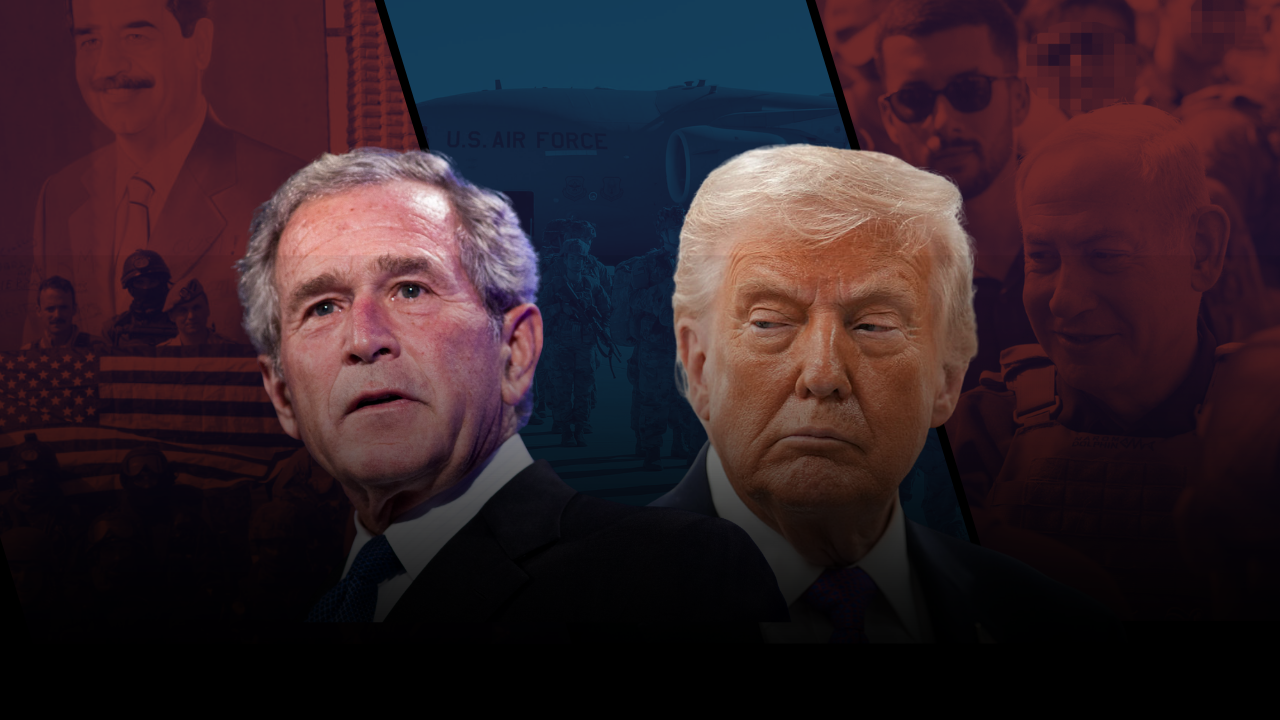
When American weapons violated Iraqi sovereignty in 2003, the intent was something that only the Bush Administration could justify, or it seemed so. They claimed that Operation Iraqi Freedom was necessary to ‘disarm Iraq, remove Saddam Hussein, and free the Iraqi people from tyranny.’ Twenty-three years later, evolved versions of the American bombs violated Iranian sovereignty, with objectives that the Trump Administration is still scrambling to finalise. At the start, they could recite a clean list, ‘destroy Iranian missiles, ensure a regime change, and free Iranians from tyranny.’ In both cases, the White House had its list. In both cases, the list was where the thinking ended.
The United States has just concluded the kinetic phase of Operation Epic Fury against Iran. A ceasefire is technically in place, but Israel is tingling to violate it. As the logistics of Hormuz are still unclear, oil prices have surged past $120 a barrel, and the IEA has called this the largest supply disruption in the history of the global oil market. The parallels to 2003 are not incidental. They are structural — the product of a recurring American failure to distinguish between military objectives and strategic outcomes.
Military destruction of non-existent WMDs
When Operation Iraqi Freedom launched on March 20, 2003, CENTCOM's campaign plan was clear about military objectives: destabilize and overthrow the Iraqi regime, destroy its WMD capability, and support conditions for long-term stability. What followed the military victory, however, revealed the hollowness beneath those objectives. As Brookings Institution analyst Michael O'Hanlon documented in a seminal post-war assessment, many basic tasks that should have been seen as necessary in Iraq — policing the streets, guarding weapons depots, maintaining public order — were simply not planned for. Post-war planning, conducted largely out of the office of Under Secretary of Defense Douglas Feith, was reportedly unfocused and too dependent on optimistic scenarios. The initial chaos was attributed by Secretary Rumsfeld to the fact that "freedom's untidy."
A classified RAND Arroyo Center study, later declassified and published, concluded bluntly that planning was effective in producing a quick defeat of Iraqi military forces yet ineffective in preparing for postwar operations. A US Government Accountability Office (GAO) report from 2007 further confirmed that the Iraqi Freedom war plan did not consider the possibility of protracted, organized Iraqi resistance after the conclusion of major combat operations, noting that the plan assumed the bulk of the Iraqi government would remain intact and that the regular army would capitulate and provide internal security. These assumptions were not just wrong — they were never tested against branch plans or contingencies.
The Council on Foreign Relations, reviewing the legacy of the Iraqi Freedom War in March 2026, noted what may be its defining verdict: the United States quickly discovered that military success did not equal political victory. Inspectors found no WMD. The insurgency swelled from an estimated 5,000 fighters in mid-2003 to upward of 20,000 by mid-2004. The mission had no coherent end state beyond a banner on a flight deck.
When Epic Fury is there, but a target isn’t
Operation Epic Fury was launched on February 28, 2026. The White House was emphatic about its military objectives: destroy Iran's ballistic missile arsenal and production sites, ensure a regime change and hoped to install the previous monarch, who was more enthusiastic towards a US influence in their country. Administration officials repeated these objectives in nearly identical language across dozens of press appearances — a rhetorical discipline that gave the impression of strategic coherence where there was, in fact, strategic ambiguity.
The Arab Center Washington DC, in a March 2026 analysis titled "Epic Fury: Washington's Contradictory War Aims in Iran," identified the core problem: although the declared objective of the joint attack was the destruction of Iran's nuclear and missile programmes, Trump had also suggested in his opening address that the broader aim was regime change from within, without specifying how this might be achieved. The BBC's reporting from March 2, 2026, summarised plainly that "Trump's Iran endgame [was] unclear after mixed messaging on war aims." The CSIS noted in a contemporaneous assessment that the operation might transform into a broader and more diffused conflict that could prove difficult to manage — and that the strikes differed drastically from the more limited Operation Midnight Hammer in that they appeared to be an initial salvo of a longer conflict aimed at systematic government degradation, without a defined political terminal condition.
The shifting rhetoric was damning. By Trump's own documented statements — from "We won the war" on March 3, to "We need help to open the strait" on March 14, to "We will bomb them for two to three weeks until we return them to the Stone Age" on April 1 — the administration appeared to be improvising its end state in real time, much as the Bush administration improvised its post-Saddam political architecture in 2003.
Who’s paying the Hormuz Bill?
In 2003, the unplanned consequence was an insurgency. In 2026, it is a global energy shock of historic proportions.
Iran closed the Strait of Hormuz on March 2, 2026. Through this narrow waterway passes approximately 25% of the world's seaborne oil trade and 20% of its LNG. The Federal Reserve Bank of Dallas modelled the closure as removing close to 20% of global oil supplies from the market, projecting that it would raise WTI prices to $98 per barrel and cut global real GDP growth by an annualised 2.9 percentage points in Q2 2026 alone. That was the conservative scenario. In reality, Brent crude surged past $120 per barrel. QatarEnergy declared force majeure on all exports. Iraq began shutting down operations at the Rumaila oil field for lack of storage. Qatar's energy minister warned that "this will bring down economies of the world."
UNCTAD warned that the disruption would intensify cost-of-living pressures most acutely for developing economies with limited fiscal space. The World Economic Forum reported that the IEA's head, Fatih Birol, described the crisis as the largest supply disruption in the history of the global oil market. The Atlantic Council noted the Hormuz closure would cascade through petrochemical supply chains, food systems, fertilizer markets, and EV battery inputs — with benefits accruing principally to China and Russia.
None of this was operationally planned for. Much as the Bush administration failed to plan for what would happen after Saddam fell, the Trump administration appears to have launched Operation Epic Fury without a publicly articulated framework for what would happen if Iran, instead of capitulating, chose to wield the Hormuz lever.
The War Planning beyond missiles
This comparison is not merely rhetorical. In 2003, the US entered Iraq with military clarity and strategic vacancy, produced a military victory, and then spent years improvising political outcomes while an insurgency grew. In 2026, the US entered Iran with military clarity and strategic vacancy, produced a military victory, and then found itself asking Arab states and NATO to help reopen a strait it had no plan to manage.
And rather than achieving its broader strategic wins in the region, the United States has managed to inadvertently elevate Tehran’s position, based on its geography. Iran historically played a marginal role in the functioning of the Strait of Hormuz, with now Iran being at a position where providing a safe passage at a historic chokepoint, becomes a service for which they have a right to payment.
What the United States has not learned — across administrations, across ideologies, across two decades — is that military objectives and strategic outcomes are not the same thing. Destroying an enemy's military capacity is a means. It is not the end.
When the bombs stop, the political vacuum, the economic consequences, and the regional instability remain. History did not repeat itself in 2026. But it rhymed loudly enough to be heard from the Strait of Hormuz to the futures markets in London.
Shreya Iyer