
In the Bhagavad Gita, Lord Krishna elucidates the concept of Dharmayuddha: the righteous war fought not for personal gain but to uphold justice and duty. Operation Sindoor, India’s decisive response to the Pahalgam terror attack that claimed 26 lives, embodies this principle. It is a testament to India’s diplomatic, strategic, and defence prowess, deeply rooted in the ethos of Aatmanirbhar Bharat (self-reliant India). Through indigenous innovations, diplomatic outreach, and a comprehensive strategy, India demonstrated its ability to protect national interests while drawing on the ancient wisdom of Kautilya’s Arthashastra in its National Security Policy.
Saam, daam, bhed, danda
The upayas are identified by Kautilya as basic forms of political behaviour which aim at enforcing one’s will against the resistance of others through conciliation (saam), gifts (dana), and dissension (bhed) until the inevitable use of force (danda). India’s bilateral relationship with Pakistan has followed the upaya system.
While the signing of the Indus Water Agreement by Former PM Jawaharlal Nehru in 1960 or Former PM Atal Bihari Vajpayee’s visit to Lahore in 1999 can be taken as attempts for saam, but these were followed by the 1965 War and the Kargil Attack, respectively. If diplomatic negotiations prove unsuccessful, we resort to dana, i.e. we pay a price for enforcing our will through gifting or favours. Thus, the already low trade relations were suspended after the Pahalgham Terrorist Attack due to national security reasons, and the Indus Water Treaty was put in ‘abeyance.’
Kautilya suggests a transition to the third step of sowing discord (bhed), which is a method of diplomacy that uses ‘agents of influence’ like local leaders or discontented clans to use their selective preferences to destabilise the state. Danda, the use of force, is the last resort, and Kautilya advises the stronger nation to opt for it along with the dual policy (dvaidhabhava) of any of the six-fold measures.
Operation Sindoor, a tri-services response characterised by precision and tactical measures to achieve strategic gains, was successful in eliminating Pakistani state-funded terrorist infrastructure, nine terrorist sites, air bases, hundreds of terrorists and reaffirmed the nation’s assertive stand against terrorism. As the upaya system remains progressive, India is now focused on multilateral diplomatic measures to ensure condemnation and action against terrorists and perpetrators of terrorism.
Strategically, Operation Sindoor was a masterclass in holistic planning, employing a five-fold response that integrated military precision, economic pressure, informational clarity, diplomatic outreach, and internal vigilance. Military strikes targeted terrorist infrastructure, while economic measures squeezed the adversary’s resources. Informational campaigns clarified India’s stance to domestic and international audiences, culminating in a strategic pause that demonstrated restraint. This comprehensive strategy ensured that the operation achieved its objectives without unnecessary escalation.
India’s diplomatic acumen shone brightly during Operation Sindoor. Following the precision strikes, delegations were dispatched to key nations to articulate India’s rationale. By contextualising the operation within its counter-terrorism framework, India preempted criticism and managed the global narrative effectively. These diplomatic missions ensured that the world recognised India’s actions as a justified response to state-sponsored terrorism, reinforcing its stature as a responsible global power.
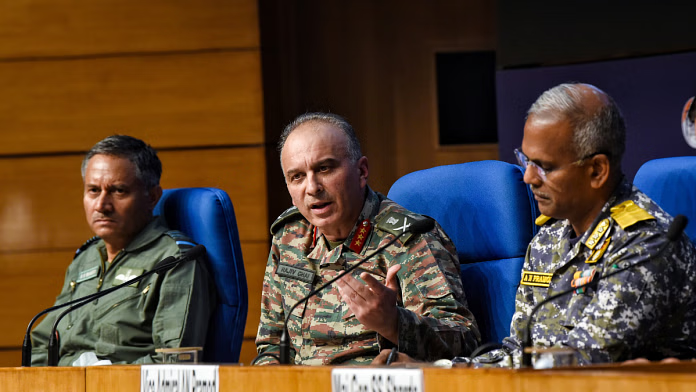
As CDS General Anil Chauhan emphasised in his address on national security architecture, “We have raised the bar as we have connected terror to war,” highlighting Pakistan's policy to “bleed India by a thousand cuts” and affirming that “India is not going to live under the shadow of terror and nuclear blackmail.”
The backbone of Operation Sindoor’s success was India’s defence prowess, exemplified by indigenous systems developed under the Aatmanirbhar Bharat initiative: Akashteer, a cutting-edge digital command centre, provided real-time situational awareness, enabling swift responses to aerial threats. The Akash missile system, known for its versatility and precision, effectively intercepted enemy drones and missiles, solidifying its role as a cornerstone of India’s air defence. These homegrown innovations neutralised immediate threats and reduced reliance on foreign suppliers, embodying India’s commitment to self-sufficiency.
The clarity of intent was portrayed just as much by the DGMOs, the Foreign Secretary and other army personnel entrusted with India’s approach in Operation Sindoor. CDS Anil Chauhan further analysed this in his remarks, stating, “Pakistan wanted a 48-hour operation, we shut it down in 8.”
At the 16th Air Chief Marshal LM Katre Memorial Lecture in Bengaluru, Air Chief Marshal Amar Preet Singh reflected, “Some people very close to me said, 'Aur maarna tha'. But can we continue to be at war?... The nation has taken a good decision,” emphasising measured response over prolonged conflict. Kautilya posited that war (vigraha) is the last resort, undertaken solely to safeguard national interest, not for glory. Having neutralised the terrorist threat and reaffirmed its resolve, India prudently accepted a ceasefire proposed by the weakened enemy. This decision reflects the ethos of Dharma and a commitment to peace, prioritising long-term stability over transient victories.
He further said, “The biggest lesson that we have learned from today's geopolitics is to be self-reliant,” and stressed that “no operations can be done without air power, and the recent Operation Sindoor was testimony.” This cessation aligns with Kautilya's dvaidhabhava, which translates to diplomatic double-game and means balancing force with prudence to secure enduring gains. Thus, Bharat continues to hold its righteous position, guided by ancient wisdom in tackling every problem that arises and protecting all Bharatiye at all costs.
Somya Maan