
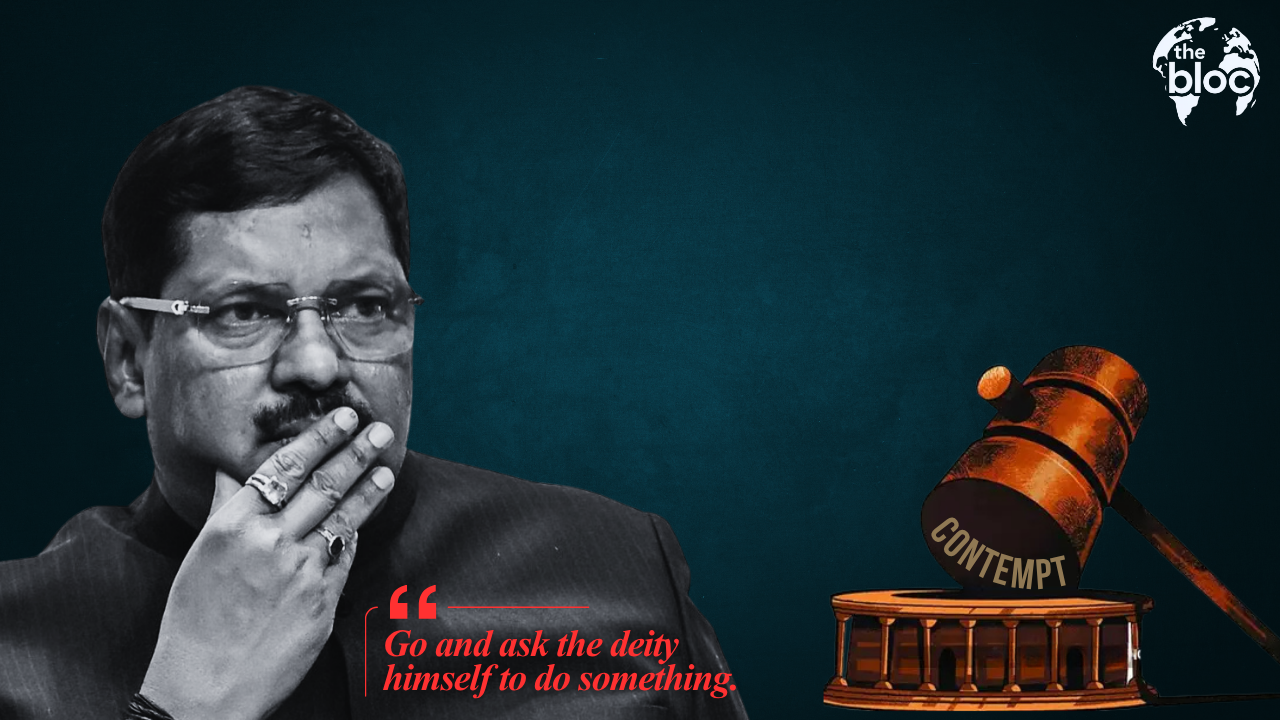
A few days ago, what began as an ordinary court proceeding soon turned into a nationwide controversy. While hearing a petition, Justice B.R. Gavai, along with Justice K. Vinod, considered a request for the reconstruction and reinstallation of a damaged idol of Lord Vishnu in the Javari Temple at Khajuraho, a UNESCO World Heritage site in Madhya Pradesh. The petitioner invoked religious faith, arguing that the absence of the idol diminished the spiritual sanctity of the temple. The bench ruled that issue fell within the jurisdiction of the Archaeological Survey of India and not the Supreme Court, that was the official order while dismissing the plea but Justice Gavai made a remark which went viral.
“This is a purely publicity interest litigation... Go and ask the deity himself to do something. If you are saying that you are a strong devotee of Lord Vishnu, then you pray and do some meditation”
At first glance, Justice Gavai’s remark may have appeared to be a casual comment. Yet in the courtroom, a judge’s words are never just personal utterances – they carry the weight of the judicial office and authority of law. When a litigant’s plea is mocked or dismissed , driven by personal beliefs, bound in sarcasm, it raises deeper questions about judicial accountability.
The Indian Constitution, through Article 141, grants the Supreme Court a unique authority: all courts in India are bound by the law declared by the Supreme Court.
This provision establishes judicial decisions not merely as judgments in a single case, but as precedents with the power to shape national legal discourse.
However, this exceptional power also places a corresponding responsibility on Supreme Court Judges— that is, to ensure that their conduct, language, and reasoning reflect the highest standards of judicial neutrality and constitutional morality.
In the controversy surrounding Justice B.R. Gavai’s comments during the Khajuraho idol case, the public reaction revealed a discomfort not necessarily with the legal outcome, which was a dismissal on procedural and jurisdictional grounds, but with the tone and manner in which religious sentiment appeared to be addressed.
In my view, the statement made by the incumbent Chief Justice was not appropriate. The position holder of such an esteemed office should be mindful that such remarks could hurt people’s religious sentiments. But what is even more problematic is that after making the statement, imposing contempt of court on critics is completely contradictory to the fundamental rights of Indian citizens living in a democratic country. This cannot be done, because it undermines the entire democratic structure and the fundamental right to freedom of speech guaranteed by the Constitution to citizens under Article 19 (1)(a).
People have every right to express their views. The Supreme Court’s role is to act as the guardian of rights, but if it uses contempt of court as a tool to silence dissent, it becomes a matter of great concern. It will put at stake the people’s trust in the Judiciary. If neutrality itself is lost, public confidence will also collapse. If such statements keep coming, people may eventually start calling for greater judicial accountability.