
For months, India has been a country on edge. From the calls for autonomy in Ladakh, to the rage of agrarian anger in Punjab and the frothing student rebellion in Delhi, the multitude and sweep of protests between August and October 2025 left none with illusions about what was happening. And though each episode has its own specific match that lights the fire, together they ask a larger question: Are these just other scattered problems that need to be solved with law and order, or are they symptoms of a foundational crack in India’s social contract? We need not to look further than our own neighbourhood, where internal instability has toppled governments, to send a shared wave of terror. Is India also at a critical historical juncture? To answer that, we must stop viewing these movements as mere 'law and security problems' and start analyzing them as profound signs of systemic governance failures. What is the true nature of these protests, and does a similar fate lie ahead for us?
The recent protests in Ladakh for the Sixth Schedule were probably the most geopolitically sensitive movement. Since late 2024, activists in Ladakh under leadership of Sonam Wangchuk and Leh Apex Body have petitioned for statehood and constitutional safeguards with tribal character for the region as well as control over land and resources by local people. Tensions escalated on September 24, 2025 when violence broke out in Leh after a BJP office was reportedly torched. Police firing resulted in four deaths and injuries to dozens leading to withdrawal from talks with the Union Home Ministry by the Leh Apex Body. Mobile internet was suspended and several arrests made under the National Security Act. Such turmoil poses grave concerns about internal security given the importance of Ladakh which is located along the China border. Any breakdown in public trust here will not only undermine local governance structures but also could open up defense susceptibilities and result in foreign manipulation through information operations or proxy support deployment.
Similarly in other parts of India the situation was worsened by the way of the urban and youth - led protests. On August 24th, about one hundred thousand people met at Ramlila Maidan, Delhi to oppose various irregularities in the SSC recruitment exams/youth unemployment and institutional mismanagement drawing attention to the same. Strategically such incidents indicate an increased separation within academic spaces and highlight how people begin to doubt institutions more and more. When public exams no longer have credibility along with students’ voices being marginalized, it is more than just protest; it is a generational disenchantment that undermines social consequences and societal stability.
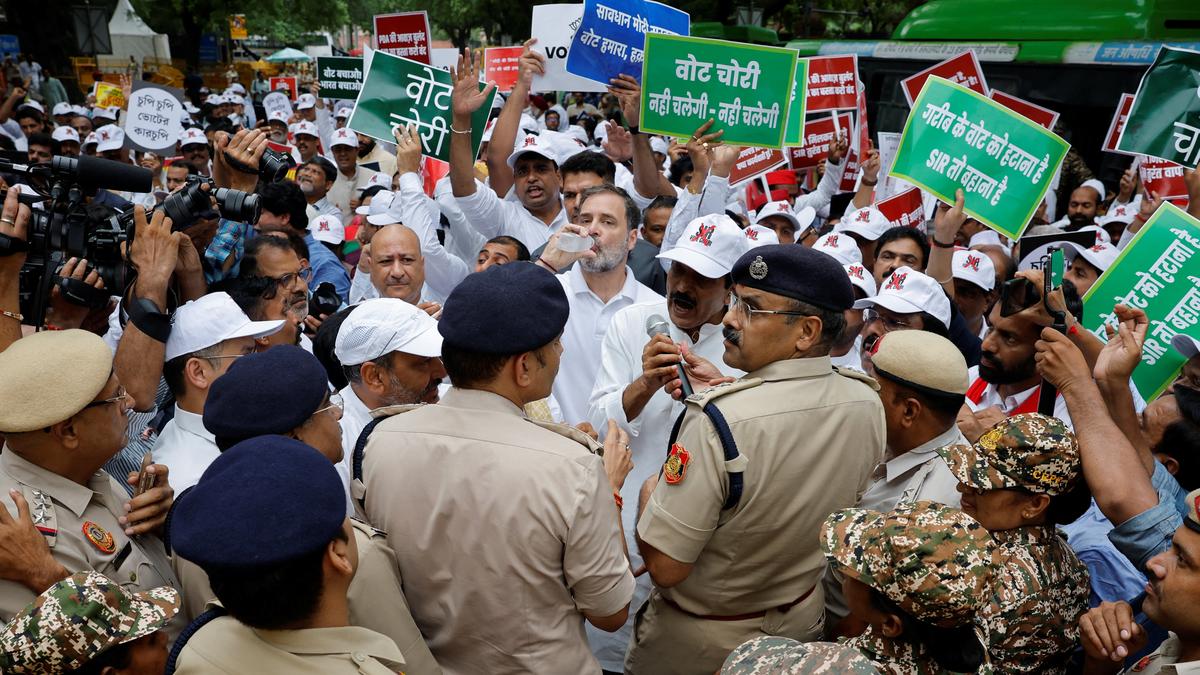
Further fuelling the political landscape, the INDIA bloc did a protest march on August 11 over what it alleged was the improper revision of electoral rolls in Bihar in the past. Detained while they were trying to reach the Election Commission of India, opposition MPs pointed fingers at the government saying that the democratic process was being killed. From a security perspective, such narrative building that attempts to create mistrust against government institutions needs to be dealt with utmost caution, as it can lead to anarchy and pose an internal instability threat.
In Maharashtra such processes have been demonstrated by two parallel protest movements, directed against the economic as well as communal malpractices. On October 8th, Shiv Sena (UBT) organized “Hambarda” rallies demanding higher compensation for farmers hit by rain. Their demand of ₹50,000 per hectare shines a spotlight on the continued agrarian distress and also the growing distance between state relief and rural aspirations. Just days before in Ahilyanagar communal tensions flared up when a graffiti reading “I Love Muhammad” near a temple caused stone pelting and road blockades were put up. These events indicate dual menace; first being agrarian discontent which is largely caused due to climate change and economic pressures and second, a communal flashpoint that can easily be ignited with symbolic provocation.
Land and development related disputes as in Karnataka and Andhra Pradesh also emerged where the farmers agitated against what they referred to as forced land acquisition. On 16th of September, BJP leaders in Karnataka opposed alleged acquisition without consent by the Congress government. On 1st of October, farmers in Andhra Pradesh took to the streets protesting land being acquired for a Google data center by demanding employment and rehabilitation. Such protests highlight issues about displacement caused by rampant urban development and show urgency of participatory planning, particularly in India's case where digital and industrial infrastructure are fast developing.
In Punjab, the ongoing farmers’ protests over low paddy prices and deficient flood relief have brought out internal divisions within farmer groups. On October 9 in a rare show of unity the leaders of Congress and BJP together protested against the alleged sacrilege of a temple in Bathinda. The similarity accentuates that religious sentiment is still one of the live wires in Indian protest politics. At a strategic level, these actions can either promote bipartisanship or be used to evoke communal sentiment depending on the way they are handled.
These examples demonstrate how internal security is being transformed by the current wave of protests across India and how open such protests are to foreign influence. Despite the fact that they are grounded in local specific grievances, like demands in Ladakh, student protests in Delhi and agrarian unrest in Andhra or Punjab; these movements bear the characteristics of a global trend where domestic dissent is increasingly exploited by external actors. For instance, though locally driven, the 2019 Hong Kong protests were internationalized through international narratives and foreign support leading to becoming a geopolitical flashpoint. Such scenarios have been visible in Western democracies as well, wherein adversaries employed misinformation for polarizing public opinion and weakening institutional trust.
This proximity to hostile borders makes regions like Ladakh particularly sensitive. It can be used by such adversaries as China or Pakistan in the forms of information operations, proxy networks, or digital disinformation. Online manipulation is also a danger for urban and student-led protests where foreign-based accounts can spread inflammatory content, deepen divisions, and undermine public confidence in governance.Misinformation is rapidly spreading, with most cases happening in social media networks that are often encrypted or in a foreign hosted site, this poses a new challenge to internal security. Old policing techniques by themselves cannot thwart these dynamic dangers.
In order to solve this, India must have a well-thought strategy in place. These involve digital surveillance upgrading, foreign-funded entities regulation in sensitive sectors, and partnering with global tech firms for real-time content monitoring.
Civic education and media literacy have to be boosted so that societal resilience against external manipulation can be developed. Internal security is now required to combine physical preparedness as well as digital defense and inclusive governance in order to keep national stability in today’s ever more interconnected and contested global environment. Finally, internal stability should not just be perceived in terms of law enforcement measures but also public ownership agendas, development that incorporates people at its core and community trust must characterise it.